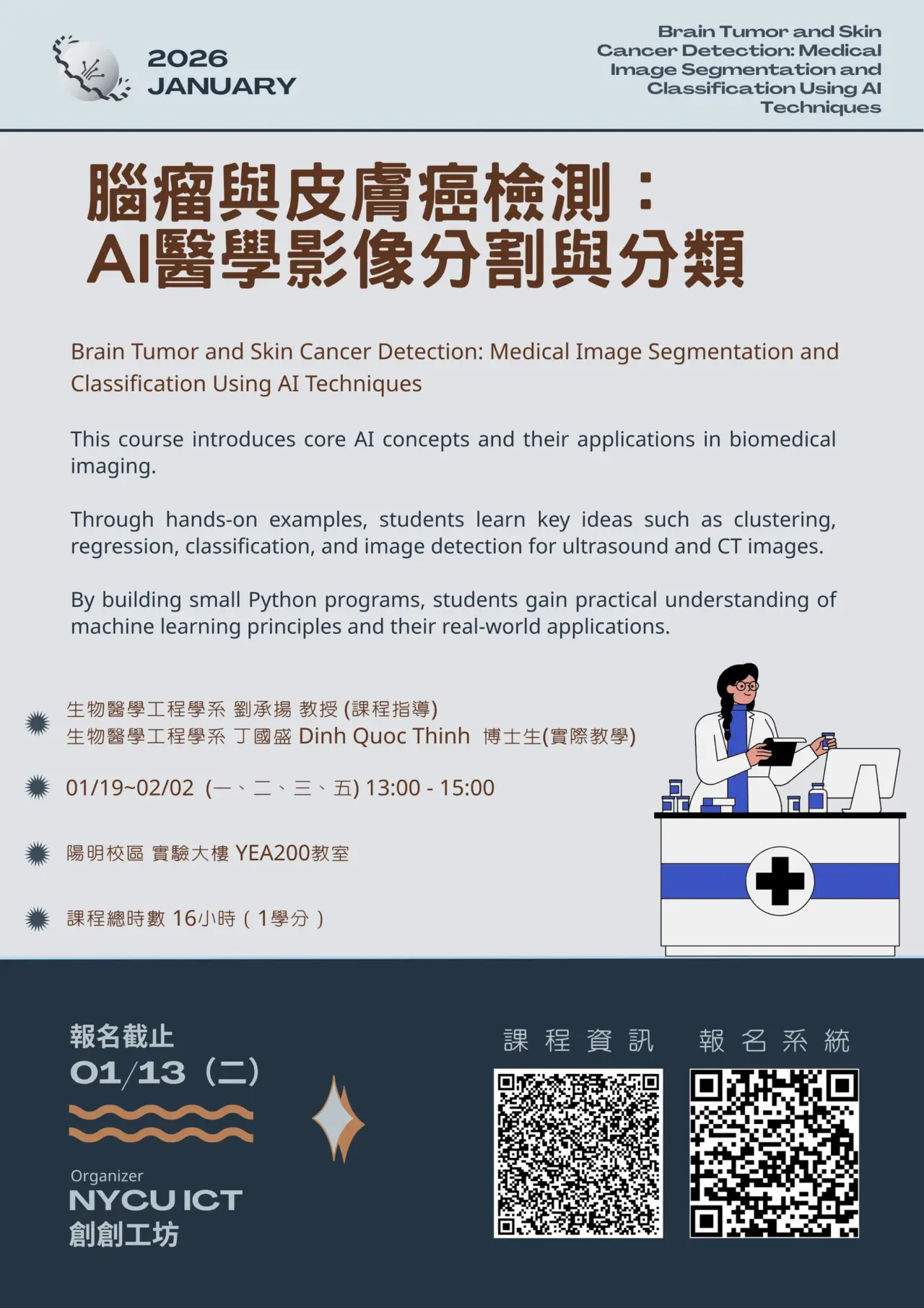
【114-1微學分課程】腦瘤與皮膚癌檢測:AI醫學影像分割與分類 (EMI) Brain Tumor and Skin Cancer Detection: Medical Image Segmentation and Classification Using AI Techniques

人工智慧微學程


This course introduces basic artificial intelligence concepts and shows how they are used in biomedical imaging.

Students learn core ideas such as vector math, clustering, regression, gradient descent, and classification through simple and clear examples.

The course also focuses on image detection in biomedical imaging, demonstrating how AI can identify and process images like ultrasound images, CT images.

The course focuses on learning by doing. Students build small programs step by step to understand how algorithms work inside. After completing the course, students will be able to understand key machine learning ideas, apply AI methods to simple image tasks, use AI for biomedical image detection, utilize Python and basic libraries for AI projects, and connect math concepts with real-world applications

授課教師

生物醫學工程學系 劉承揚 教授(課程指導)
生物醫學工程學系 丁國盛 Dinh Quoc Thinh 博士生(實際教學)

對應總課程名稱

人工智慧應用與實作
Artificial Intelligence Applications and Implementations

課程日期

2026年1月19日~2026年02月02日
Monday: 13:00 - 15:00
Tuesday: 13:00 - 15:00
Wednesday: 13:00 - 15:00
Friday: 13:00 - 15:00
詳細日期請見課程進度表

課程總時數

16小時

上課地點

實驗大樓YEA200

修課人數

19人(開放外校選修,陽明交大在學生優先修課)

先修科目或先備能力

自備物品

Laptop/PC with Python and necessary libraries installed (numpy, pandas, scikitlearn, Pygame, matplotlib, etc.)

課程教材

Book Title: Introduction to Artificial Intelligence
Author: Wolfgang Ertel
Publisher: Springer
Year: 2018
Other Info: ISBN-13: 978-3030030074。

作業、考試、評量

1. Attendance (30%): Requirement: Attend at least 80% of the classes. Grading: Active participation in class is encouraged. Missing more than 20% of classes will reduce your grade.

2. Assignments (30%): Requirement: Complete all assignments on time. Each assignment will help you practice course concepts. Grading: Points will be given based on: • Correctness of your solution. • Clarity in explaining your work. • Use of tools like Python. • Late Submission: 10% penalty for each day late.

3. Final Exam (40%): Requirement: The final exam will test your understanding of all course topics.

• Grading: Points will be based on: • Understanding key concepts (e.g., K-Means, Gradient Descent, KNN). • Ability to solve practical problems. • Clear explanation of your answers.

課程大綱

課程大綱 分配時數
單元主題 內容綱要 講授 示範 習作 其他
Introduction to AI and Biomedical Imaging Basic AI concepts and how they apply to medical image processing 1hr - - -
K-Means and Data Visualization Learn K-Means clustering and how to visualize data 1hr - - -
Image Processing with K-Means Apply K-Means to process medical images - 1hr 1hr -
Linear Regression and Matrix Basics Introduction to linear regression and basic matrix operations 2hrs - - -
Gradient Descent and Derivatives Understanding gradient descent and its application in optimization - 1hr 1hr -
K-Nearest Neighbors (KNN) Algorithm KNN algorithm explanation and its applications in classification 2hrs - - -
Programming and Python Practices Learn Python programming and best practices 2hrs - - -
Assignments and Problem Solving Work on real-world problems and solutions - 1hr 1hr -
Final Project and Review Final project work and course review - 1hr 1hr -

課程進度表

課程進度表
日期 課程進度、內容、主題
2026/01/19 Introduction to AI and Biomedical Imaging: Overview of Artificial Intelligence (AI), its applications in medical imaging, and how AI techniques like K-Means, linear regression, and image processing are applied to medical data.
2026/01/20 K-Means and Data Visualization: Detailed introduction to clustering using K-Means.
Hands-on coding exercises where students implement K-Means to cluster medical images and visualize the clusters formed (e.g., tumor detection).
2026/01/21 Image Processing with K-Means: Apply K-Means clustering to process ultrasound or MRI images.

Students will segment images, identify different regions like tumors, and practice enhancing medical images using K-Means for better analysis.
2026/01/23 Linear Regression and Matrix Basics: Introduction to linear regression as a method to predict values from image data.

Basics of matrix operations (e.g., multiplication, inversion) and their importance in AI applications for medical images.
2026/01/26 Gradient Descent and Derivatives: Understand gradient descent optimization algorithm, its role in minimizing error during training machine learning models.

Apply gradient descent to medical data for tasks like tumor classification.
2026/01/27 K-Nearest Neighbors (KNN) Algorithm: In-depth overview of KNN for image classification tasks.

Hands-on practice with real breast cancer and brain tumor images, learning how KNN can classify images based on features like texture, shape, and size.
2026/01/28 Programming and Python Practices: Python programming techniques for working with medical images.

Introduction to image manipulation libraries like OpenCV and PIL, and learning best practices in coding for AI projects in healthcare.
2026/01/30 Final Project and Review: Students will present their final projects, such as a skin cancer detection or brain tumor classification system, showcasing their knowledge and AI skills in medical imaging. Class review of the major takeaways and learning outcomes.
2026/02/02 Backup Day
2026/02/03 Backup Day

常見問題